
There is a canyon in the high desert of Northern Nevada where the sagebrush gives way to exposed rock and the wind carries the dry scent of juniper. Most people drive past it without a second thought. The land looks sparse, sunbaked, unremarkable. But if you know where to look — if you crack open the right seam in the right formation — you will find something that stops you cold: a flash of electric lime green, vivid as spring growth against the brown and grey of ancient stone.
This is Cortez Canyon turquoise. It is not the turquoise most people picture. It is not the robin’s-egg blue of the Southwest souvenir shop. It is a geological anomaly — a zinc-rich variant of turquoise so rare that it occurs in meaningful quantities in only a handful of locations on Earth, and in its highest grades, almost nowhere outside these Nevada formations. The color is not dyed. It is not treated. It is the stone’s honest chemistry, written into the crystal lattice millions of years ago.
This guide is your starting point. Whether you are a collector, a silversmith, a geologist, or simply someone who picked up a green stone and felt something — you are in the right place. In the pages that follow, you will learn what makes this turquoise different, where it comes from, how to evaluate it, and how to buy with confidence. Consider this your walk through the canyon.
The story of the man who first recognized this stone’s singular beauty.
What Is Cortez Canyon Turquoise?
At its most basic, turquoise is a hydrous phosphate of copper and aluminum. Its chemical formula — CuAl6(PO4)4(OH)8·4H2O — reads like a recipe, and like any recipe, small changes in ingredients produce dramatically different results. In most turquoise deposits around the world, copper is the dominant chromophore. Copper gives turquoise its classic blue. The more copper, the deeper the blue. This is what most people think of when they hear the word “turquoise.”
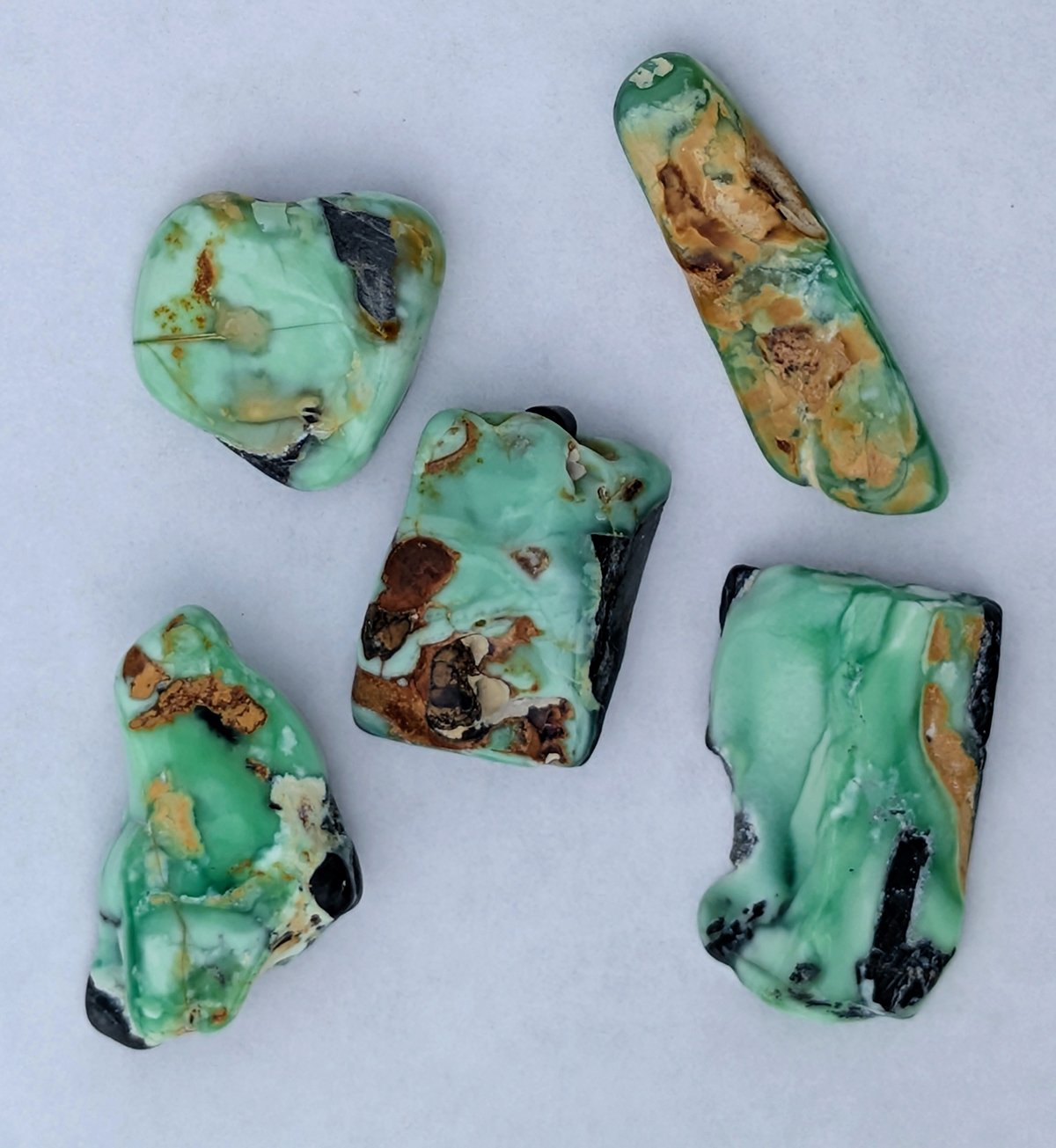
Cortez Canyon turquoise breaks the pattern. In these formations, zinc partially replaces copper within the crystal lattice. This substitution shifts the stone’s color from blue toward vivid lime green, mint green, and occasionally a deep, saturated sage. The effect is not subtle. Place a Cortez Canyon specimen next to a Sleeping Beauty cabochon and they look like entirely different minerals. In a sense, at the atomic level, they are.
The geological setting that makes this possible is specific and rare. Cortez Canyon sits within Paleozoic sedimentary rocks that have been thrust-faulted and fractured by the Basin and Range tectonics that shaped the modern Nevada landscape. These deep structural fractures created pathways for mineral-rich fluids to percolate through the rock over millions of years — fluids carrying copper, aluminum, phosphorus, and critically, zinc from nearby zinc-bearing mineral deposits. The result is not simply a color variant of turquoise. It is a geological anomaly, a product of a precise set of conditions that aligned in this stretch of Nevada desert and very few other places on the planet.
The deep science behind the color.
The Orvil Jack Legacy
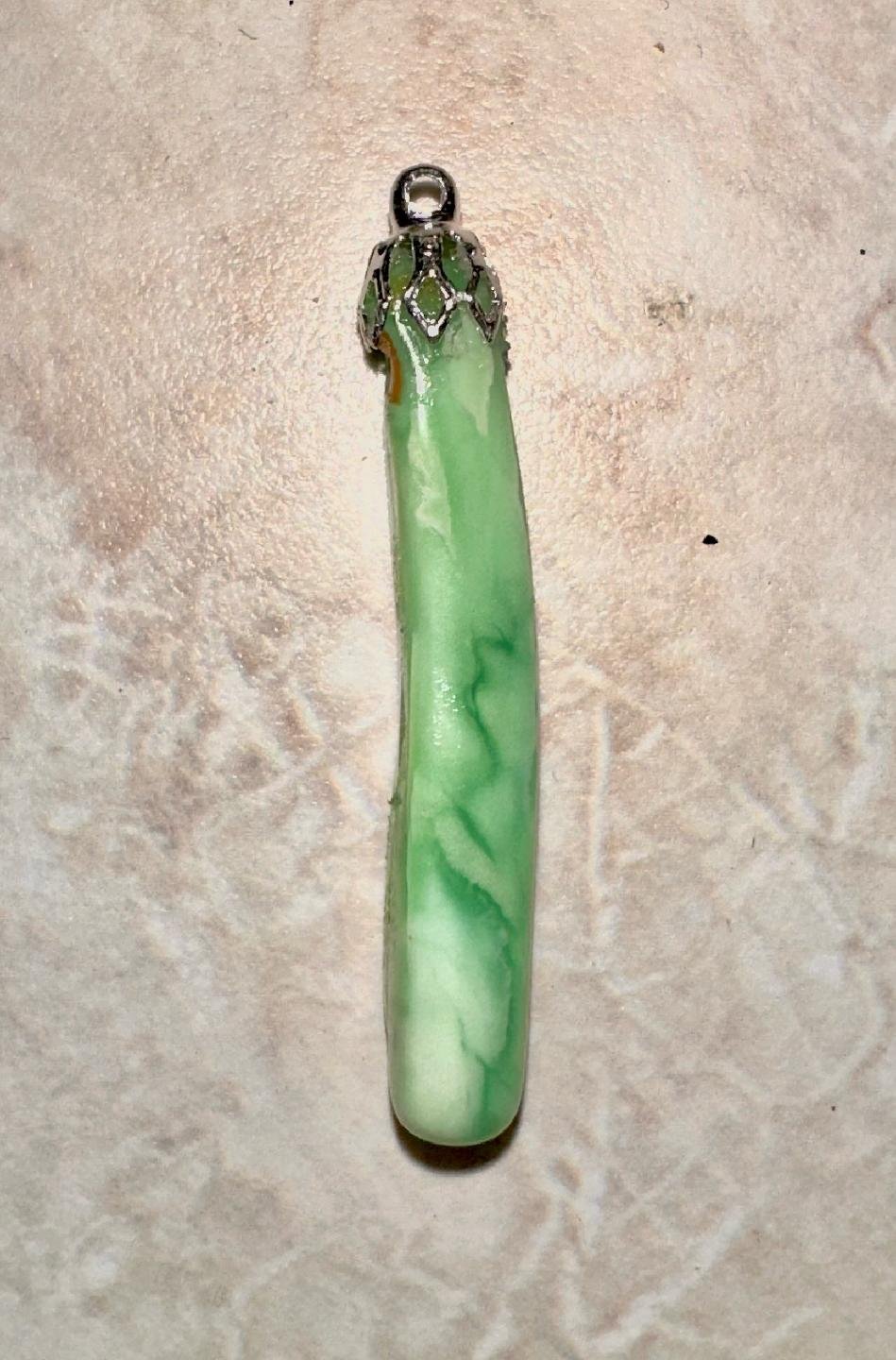
Classic Orvil Jack turquoise — the vivid green material that was once discarded as “off-color” before the world recognized its rarity.
The story of green turquoise in this part of Nevada begins with one man and one family. In 1956, Orvil Jack moved his wife Bessie and their children to Nevada and staked a handful of turquoise claims. He named the operation Blue Ridge. For the better part of three decades, the Jacks mined classic blue spider-web turquoise — the kind that the market understood, the kind that jewelers wanted, the kind that sold.
The lime green material they encountered along the way was treated as waste. “Growing up, I remember we rarely came across a lime green turquoise piece,” Orvil’s daughter Grace Jack Wintle later recalled, “and when we did, we were told to throw it down — it just wasn’t good enough to keep.” The green stones went onto the tailing piles, mixed with the overburden, forgotten.
That changed in 1983, when Orvil himself recognized the singular beauty of the green vein he had been discarding for years. He began setting the lime green material aside, keeping most of it, selling only small, select amounts. It was a quiet pivot — no press release, no marketing campaign. Just a miner’s eye finally seeing what the earth had been offering all along. Orvil Jack passed away in 1986, only three years after he began collecting the green material in earnest. After his passing, bead makers Bob Hall and Lee Louden worked with the family to mine and popularize the lime green stones, introducing them to a wider market that had never seen anything quite like them.
Today, the original Blue Ridge mine has not been in operating condition for many years. Orvil’s original stash of lime green turquoise has become some of the most collectible turquoise on the planet — true old-stock material, finite and irreplaceable. Cortez Canyon Gems works extensions of these same Nevada veins. The same geological formation. The same zinc-rich chemistry. The same desert. Different ground, same story written in the rock.
The full story of the man and the mine.
Why Orvil’s legacy still shapes the turquoise market today.
Why Green Turquoise Is So Rare
To understand why green turquoise is rare, you first have to understand that all natural turquoise is rare. The formation of turquoise requires a specific convergence of conditions: copper must be present, along with aluminum and phosphorus. Water must percolate through rock in arid or semi-arid conditions, slowly depositing minerals in fractures and voids over geological time. The host rock must be the right composition, the climate must be the right balance of wet and dry, and the chemistry must be the right concentration. Most of the Earth’s crust never checks all those boxes simultaneously.
Green turquoise adds another requirement to an already demanding list. For the color shift to occur, zinc-bearing minerals must coexist with the copper-aluminum-phosphorus system in the right geological context. Zinc must be available in sufficient concentration to substitute into the turquoise crystal structure, partially replacing copper at the atomic level. This only happens in specific geological windows — particular rock formations where zinc mineralization overlaps with turquoise-forming conditions. Those windows are vanishingly small.
The result is that green turquoise represents a tiny fraction of global turquoise production. And within that fraction, the range of quality varies enormously. Most green turquoise is soft — too chalky and porous to take a polish without being stabilized, which means impregnating the stone with resin to harden it. High-grade natural green turquoise, the kind that is hard enough to cut and polish on its own merits, vivid enough in color to stop you mid-sentence — that material is rarer still. Cortez Canyon material is natural. No dyes, no stabilization, no treatment of any kind. What you see is what the earth made.
The deeper significance of green in turquoise.
How to Evaluate Cortez Canyon Turquoise
Whether you are buying your first piece or adding to a serious collection, understanding how to evaluate turquoise gives you confidence and clarity. There is no single “best” — turquoise is personal, and what draws one collector may differ from what draws another. But there are four dimensions that matter, and knowing them will sharpen your eye.
Color
The color spectrum of Cortez Canyon turquoise runs from soft sage green through electric lime to deep, saturated mint. The most prized pieces typically show vivid, even color saturation — that unmistakable “neon” quality that earned the original Orvil Jack material its reputation. But variation is inherent to natural stone, and subtle shifts in tone across a single specimen are part of its character, not a defect. Unlike treated or dyed turquoise, which can look flat and uniform, natural Cortez Canyon color has depth. It may also deepen slightly over time with wear as the stone absorbs trace oils from the skin — a gentle patina that collectors consider a feature, not a flaw.
Hardness
High-grade natural turquoise rates between 5 and 7 on the Mohs hardness scale. Cortez Canyon material is known for exceptional hardness — it takes a clean, glassy polish without stabilization, which is genuinely rare in the turquoise world. The vast majority of commercial turquoise is too soft and porous to be workable without resin treatment. Stabilization is not inherently dishonest — plenty of beautiful jewelry uses stabilized turquoise — but it is a different category of material. When a turquoise stone can stand on its own, unassisted by chemistry it did not come by naturally, that is a mark of quality that experienced collectors recognize immediately.
Matrix
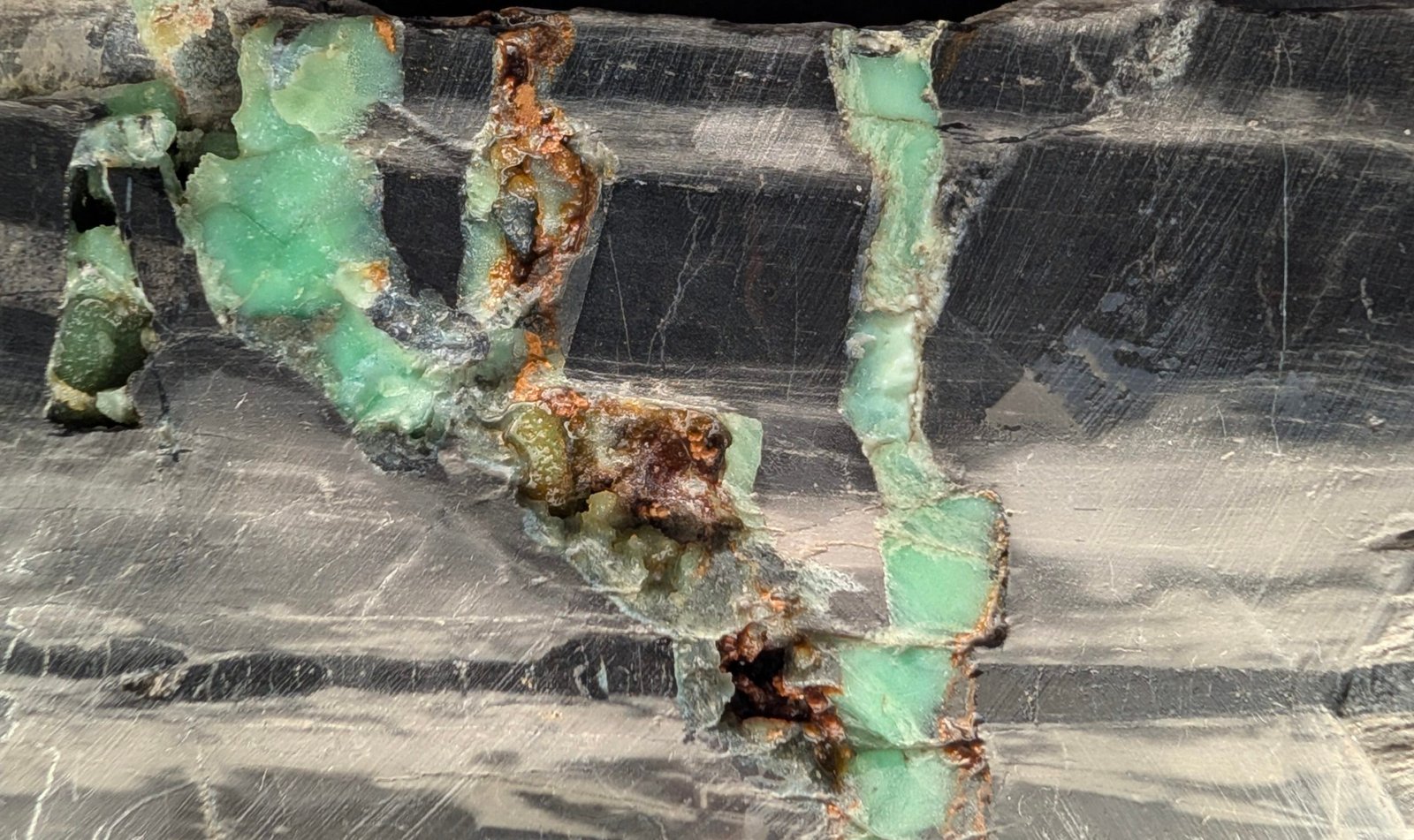
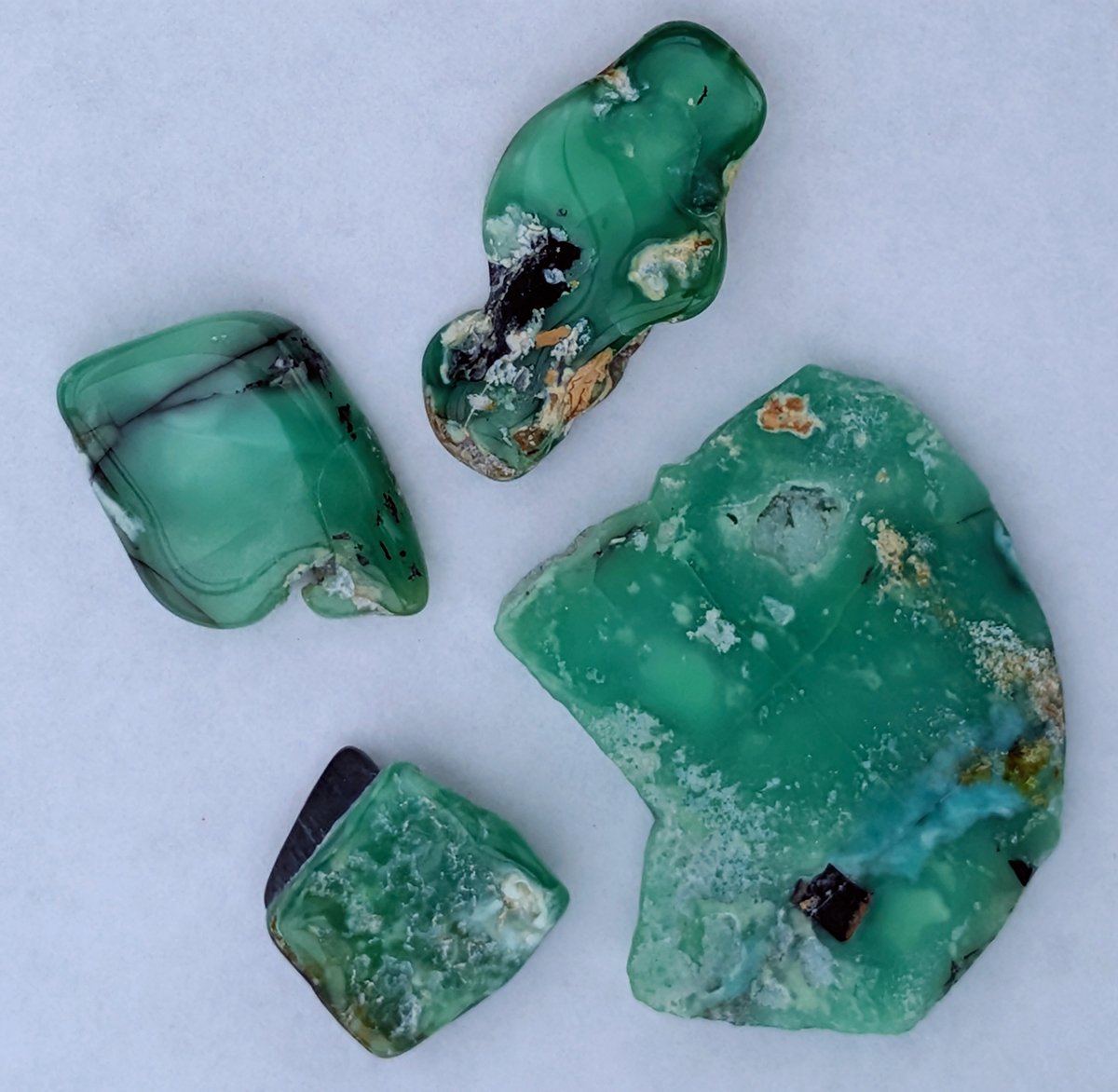
Natural matrix patterns in green turquoise — every stone carries a unique geological fingerprint.
Matrix is the host rock visible within the turquoise — the veining, webbing, and inclusions that give each stone its visual fingerprint. In Cortez Canyon stones, matrix patterns range from fine, delicate spider-web veining to bold, dramatic inclusions of dark host rock against the green. Some collectors prize clean, matrix-free stones for their pure, uninterrupted color. Others actively seek the character and visual complexity that matrix provides — the sense that you are looking at a cross-section of geological history. There is no wrong answer here. It is about what speaks to you, what catches your eye, what you find yourself reaching for.
How freeform cuts showcase matrix in new ways.
Provenance
In the turquoise world, where a stone comes from matters as much as how it looks. Mine-identified turquoise from documented sources commands higher value and greater trust than anonymous material of uncertain origin. Provenance is not just a marketing concept — it is a chain of accountability. Every Cortez Canyon Gems stone comes with provenance. You know which vein it came from. You know who pulled it from the earth. You know the chain of custody from canyon to customer. In a market where misidentification and misrepresentation are common, that transparency is not a luxury. It is a baseline.
Why knowing your stone’s origin changes everything.
Three Ways to Collect: Rough, Freeform, and Cabochon
Turquoise finds its way into the world in three primary forms, each with its own appeal and its own audience. Understanding the differences helps you decide what fits your collection, your craft, or your aesthetic.
Rough Turquoise
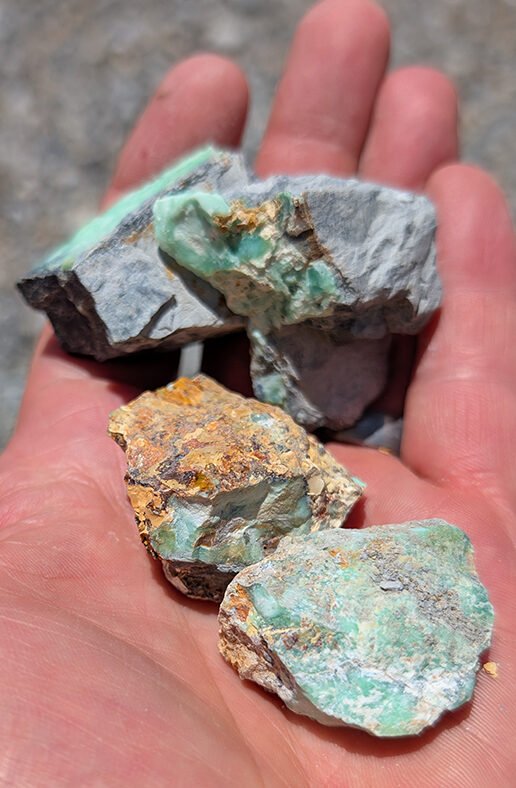
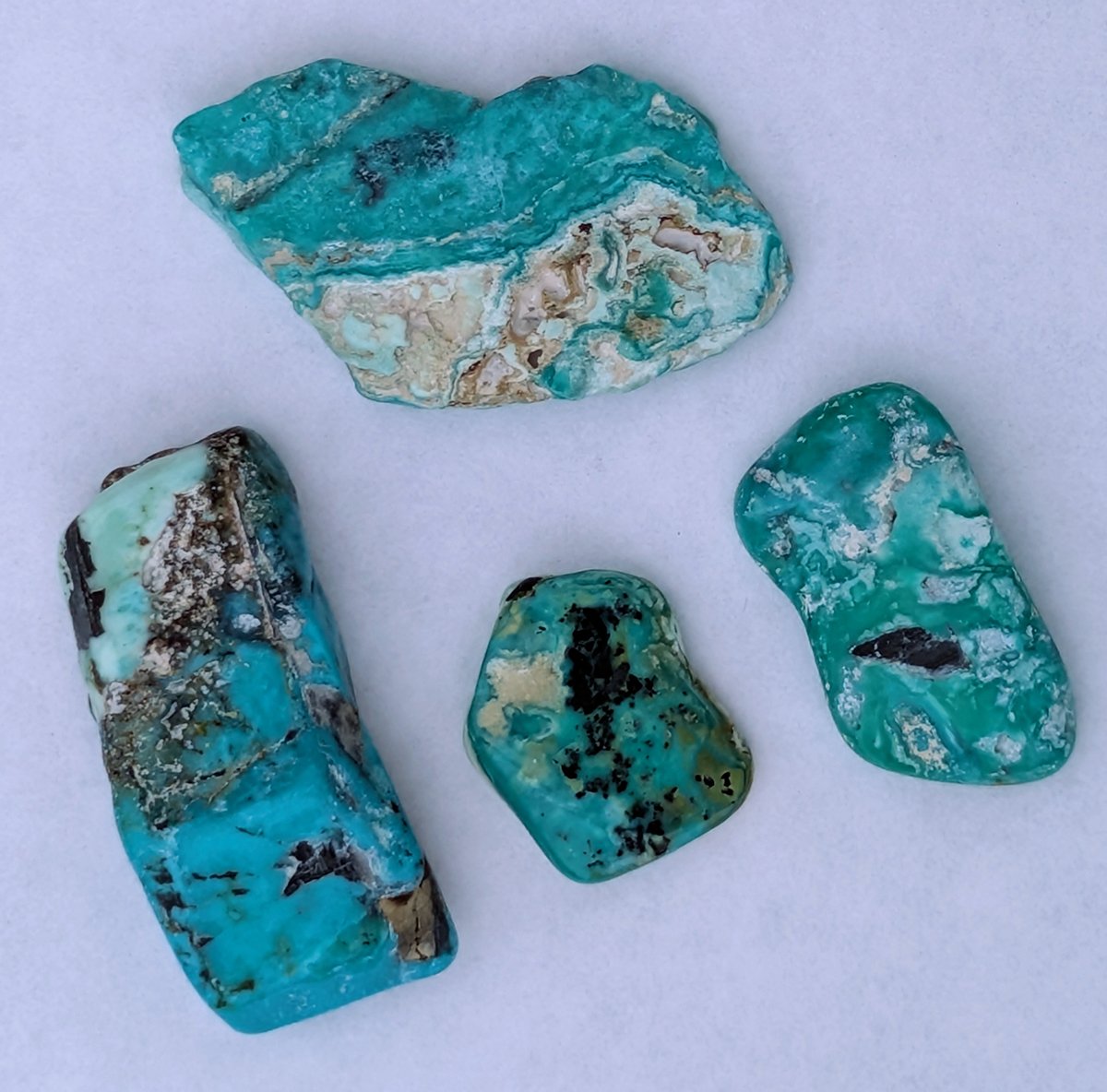
Rough turquoise — uncut, unpolished, straight from the earth.
Rough turquoise is the stone in its most natural state — uncut, unpolished, still wearing its host rock like a second skin. For decades, rough was considered raw material, a starting point on the way to something else. That is changing. Increasingly, silversmiths, jewelry designers, and collectors are drawn to rough specimens for their organic, unmediated aesthetic. A piece of rough turquoise on a shelf or set into a bezel with its natural contours intact carries a different energy than a polished cabochon. It feels closer to the earth it came from.
For artists working in organic jewelry design — the kind of work that celebrates imperfection, texture, and the hand of nature — rough specimens offer creative freedom that no standardized cut can match. Every piece is a unique starting point, an invitation to design around the stone rather than forcing the stone into a predetermined shape. Rough Cortez Canyon turquoise, with its vivid green against dark matrix and pale host rock, is particularly striking in this format.
Why rough turquoise is having a moment.
Freeform Polished Stones
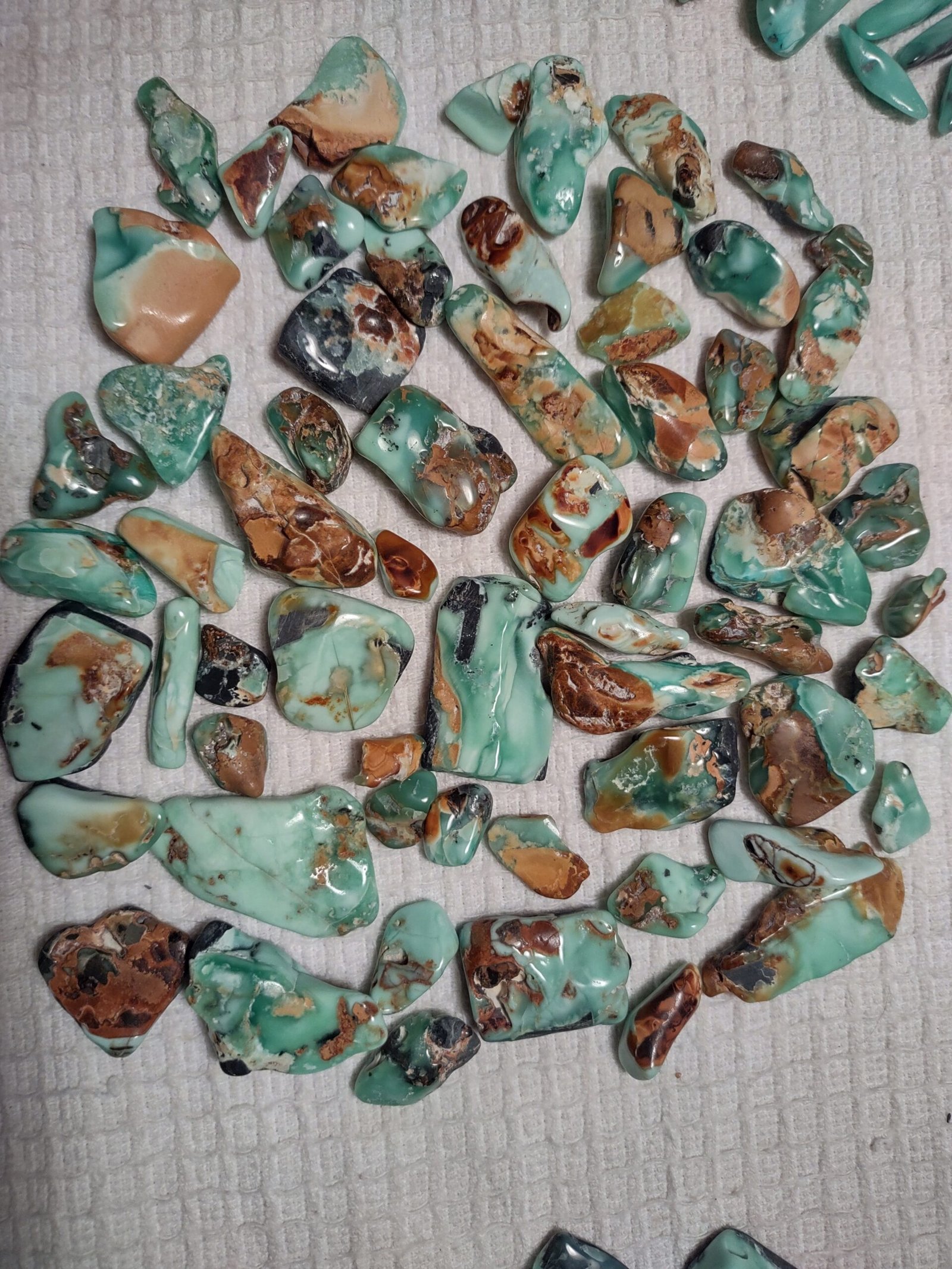
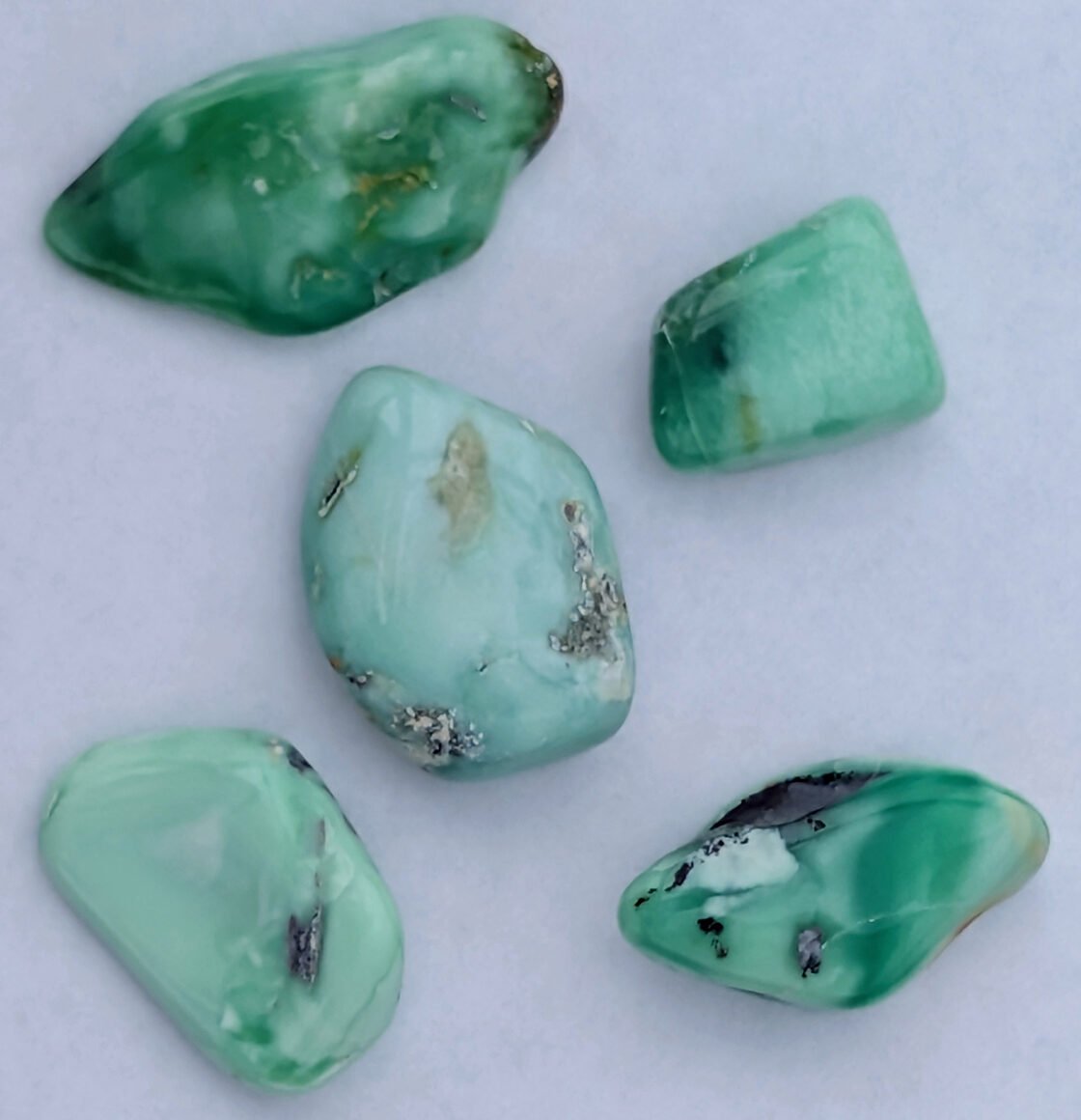
A freeform polished turquoise stone — cut to follow the natural contours of the material, not a template.
Freeform polished stones occupy the space between rough and cabochon. They are cut and polished to a smooth finish, but they are not forced into standard geometric shapes. Instead, freeform cuts follow the natural contours of the stone itself, preserving matrix patterns, respecting the material’s organic boundaries, and maximizing the unique character of each piece. No two freeform stones are alike. That is the point.
The rise of freeform cutting reflects a broader shift in the gemstone world — and in jewelry design generally — toward celebrating natural beauty over manufactured uniformity. A freeform Cortez Canyon stone is where artistry meets geology. The cutter reads the stone, identifies its strongest features, and makes decisions that honor the material rather than imposing a shape upon it. For collectors and designers who value one-of-a-kind pieces, freeform polished stones are often the most compelling format.
The art of freeform cutting.
Cabochons
The cabochon is the classic turquoise cut: smooth, domed, symmetrical, designed to fit standard jewelry settings. From traditional Navajo silverwork to contemporary minimalist designs, cabochons have been the default format for turquoise in jewelry for generations, and for good reason. A well-cut cabochon from high-grade natural material is a thing of quiet perfection — the stone’s color and character distilled into a shape that sits beautifully in a bezel, catches the light evenly, and wears comfortably against the skin. For many collectors, the cabochon remains the purest expression of what turquoise can be.
Explore our turquoise collection.
Buying with Confidence: What to Look For
The turquoise market is full of beautiful material. It is also full of confusion, misrepresentation, and outright imitation. Whether you are shopping for your first natural turquoise stone or your fiftieth, these principles will serve you well.
- Always ask about treatment. The word “natural” should mean that nothing has been added to the stone — no resin, no dye, no wax, no heat treatment. “Stabilized” means the stone has been impregnated with resin to harden it and deepen its color. Terms like “enhanced” or “treated” can mean almost anything — dyed, waxed, reconstituted, or some combination. If a seller cannot clearly articulate what has been done to the stone, keep asking until they can.
- Ask about provenance. If a seller cannot tell you which mine the stone came from, treat that as a red flag. Mine-identified turquoise from documented sources is the standard in the serious turquoise market. Anonymous turquoise of uncertain origin may be perfectly fine material, but you are buying on faith rather than information.
- Understand the value hierarchy. Natural turquoise is inherently more valuable than stabilized material. It is harder to find, harder to cut, and tells a more honest geological story. This does not mean stabilized turquoise is worthless — far from it — but the two categories should not be priced the same, and they should never be confused with each other.
- Beware of imitations. Dyed howlite, dyed magnesite, and reconstituted turquoise powder bonded with resin are common in the market, particularly at lower price points and in tourist-oriented retail. These materials are not turquoise. They may be attractive in their own right, but they should be sold as what they are, not as what they are not.
- Let price reflect rarity. High-grade natural green turquoise from documented Nevada mines is genuinely rare material. If a price seems too good to be true, it almost certainly is. Rarity has a cost, and honest sellers price their material to reflect the difficulty of finding it, extracting it, and bringing it to market with full transparency.
- Buy from sellers who stand behind their material. Transparent sourcing, clear treatment disclosure, and a willingness to answer questions are the hallmarks of a seller you can trust. The best turquoise sellers are educators as much as merchants — they want you to understand what you are buying, because understanding builds the kind of trust that lasts.
Browse mine-direct turquoise with full provenance.
The Meaning Behind the Green
Turquoise has been a sacred stone across cultures for millennia — from the burial masks of Egyptian pharaohs to the ceremonial jewelry of the Navajo, Zuni, and Pueblo peoples of the American Southwest. It has been a stone of protection, communication, and connection to the sky. Green turquoise carries its own layer of meaning within this long tradition.
Across multiple cultural and spiritual frameworks — from Native American traditions to Tibetan Buddhism to contemporary energy work — green turquoise has been associated with the Heart Chakra, the energetic center governing love, compassion, and emotional balance. The color green in turquoise carries symbolic weight that blue does not: healing, growth, renewal, abundance, and deep harmony with the natural world. Where blue turquoise is often linked to the throat, to communication, to the sky above, green turquoise is linked to the earth below, to the living systems that sustain us, to the quiet process of growing toward wholeness.
Whether you are drawn to the science of zinc substitution in a crystal lattice or to the spiritual tradition of a stone that connects you to the heart of the earth, Cortez Canyon turquoise holds space for both. The stone does not ask you to choose. It carries the geology and the meaning in the same vivid green.
Explore the cultural and spiritual significance of green turquoise.
Start Exploring
You have the foundation now. From here, the canyon branches in several directions, and each path goes deeper. The Learn section is built to let you follow your curiosity — whether that pulls you toward the geology, the history, the craft, or the spirit of the stone. Here is where to go next.
- “The Legend of Orvil Jack” — The full story of the man and the mine that started it all.
- “Provenance Matters” — Why knowing your stone’s origin changes everything about how you value it.
- “Geochemistry and Tectonics” — The deep science behind the color: zinc substitution, crystal chemistry, and Basin and Range geology.
- “The Raw Appeal” — Why rough turquoise is having a moment in organic jewelry design.
- “Beyond the Cabochon” — The art of freeform cutting and the shift toward celebrating natural form.
- “The Earthy Magic of Green Turquoise” — Color, culture, spirit, and what this stone has meant across traditions.
Each article is written with the same philosophy as this one: calm, thorough, rooted in the land and the science, free of hype. Take your time with them. There is no rush in the canyon.
Or, when you are ready, explore our collection — every stone with a story, every story rooted in the canyon.